The fire department has cleared the scene. The trucks are gone. You’re standing in front of a home that may look structurally intact from the street but has soot coating every interior surface, firefighting water soaking the subfloor, and smoke odor embedded in the framing. What happens next isn’t random — there’s a defined sequence that every competent restoration contractor follows, and understanding it helps you ask the right questions, set realistic timelines, and avoid costly mistakes during the insurance claim process.
The First 24 Hours: Stabilization Before Anything Else
Before any cleaning or reconstruction begins, the structure has to be secured. This phase is called emergency stabilization, and it happens the same day — often within hours of the fire being extinguished.
Board-up and tarping comes first. Any windows broken by heat, firefighters, or water pressure get plywood panels. Roof sections compromised by fire or suppression activity get poly tarps or temporary roofing membrane. This isn’t cosmetic — it prevents a second wave of damage from rain, wind, and unauthorized entry. In Alabama’s spring severe weather season, a compromised roof left open overnight can turn a contained fire loss into a water-damage claim stacked on top of the fire claim.
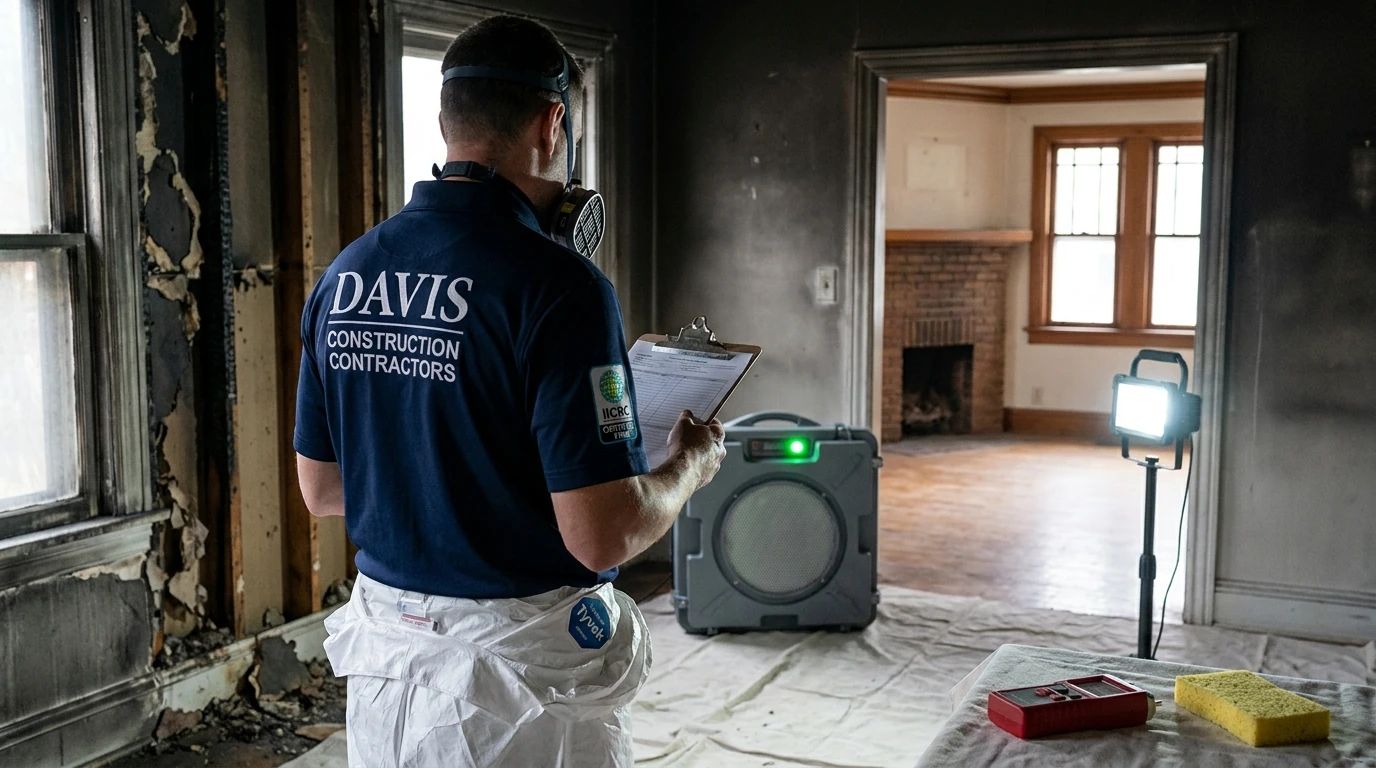
At the same time, the contractor documents everything. Photos, moisture readings, air quality measurements, and a written damage scope go into the claim file. Your insurance adjuster will want this documentation, and the more thorough it is, the smoother the claim process runs. A restoration contractor who skips this step is one you want to replace before work begins.
Step 2: Water Extraction — Yes, From the Fire
This surprises most homeowners: one of the first technical tasks after a fire is water removal. Firefighting operations can introduce hundreds or even thousands of gallons of water into a structure. That water saturates drywall, soaks insulation, wicks into hardwood floors, and pools in basements and crawl spaces.
If that water sits, mold growth begins within 48 to 72 hours — sometimes faster in a warm, enclosed space with organic material like drywall paper and wood framing. This is not a hypothetical. It’s a documented pattern that the industry S500 standard addresses directly: fire losses with significant water intrusion must be treated as concurrent water damage events.
Extraction equipment — truck-mounted or portable units capable of pulling several hundred gallons per hour — removes standing water first. Then industrial-grade LGR (low-grain refrigerant) dehumidifiers and high-velocity air movers are staged throughout the structure to drive moisture out of building materials. Restoration contractors use pin-type and non-invasive moisture meters to track drying progress in walls and floors, targeting specific moisture content thresholds before moving to the next phase. Skipping or rushing this step leads to mold colonies inside wall cavities that won’t show up visually for weeks.
If you’re dealing with a fire loss that involved significant water, the mold remediation risk is real and worth discussing explicitly with your contractor before the drying phase wraps up.
Step 3: Soot and Smoke Residue Removal
Soot is not uniform. The type of fire determines the type of residue, and different residues require different cleaning methods — this is one of the most technically demanding parts of the process and where inexperienced contractors make expensive errors.
Dry soot from fast-burning, low-oxygen fires (paper, natural wood) is powdery and responds well to dry chemical sponges and HEPA vacuuming before wet cleaning. Apply water or cleaning solution to dry soot before vacuuming and you smear it into the substrate, making it significantly harder to remove.
Wet or oily soot from slow-burning synthetic fires (plastics, foam, rubber) is sticky and penetrating. It requires chemical cleaning agents designed to break down petroleum-based residues, followed by encapsulation or replacement of materials that can’t be cleaned to an acceptable standard.
Protein residue from kitchen fires is nearly invisible but has an extremely persistent odor. It bonds to surfaces at a molecular level and requires enzymatic cleaners.
The industry’s S753 standard for fire and smoke damage restoration provides the technical framework for identifying residue types and selecting appropriate cleaning methods. A contractor working to this standard will test-clean small sections before committing to a cleaning method across an entire room.
All porous materials that cannot be cleaned to pre-loss condition — insulation, heavily contaminated drywall, carpet — get removed and disposed of at this stage. Structural materials like framing lumber are assessed individually: surface soot on intact framing can often be cleaned and sealed; charred or structurally compromised framing gets replaced during reconstruction.
Step 4: Deodorization
Smoke odor is not just a surface problem. Volatile organic compounds (VOCs) from combustion penetrate drywall, insulation, wood framing, HVAC ductwork, and soft contents. Simply cleaning visible surfaces does not eliminate odor — and a home that smells like smoke after “restoration” is a restoration that wasn’t finished.
Professional deodorization uses a layered approach:
- Thermal fogging — a deodorizing agent is vaporized and dispersed throughout the structure, following the same pathways that smoke traveled during the fire. It neutralizes odor compounds at the molecular level rather than masking them.
- Hydroxyl generators — produce hydroxyl radicals that break down odor-causing VOCs. Safer for occupied or partially occupied spaces than ozone treatment.
- Ozone treatment — highly effective but requires the space to be completely vacated (people, pets, plants) for the treatment period and a ventilation window afterward. Used for severe odor cases.
- HVAC decontamination — the duct system is cleaned and treated separately, because smoke-contaminated ducts will re-distribute odor throughout the home every time the system runs.
The EPA’s guidance on fires and indoor air quality notes that combustion byproducts — including carbon monoxide, particulate matter, and VOCs — can persist in building materials and HVAC systems long after visible damage is addressed. This is why deodorization is a technical process, not an air-freshener application.
Step 5: Structural Assessment and Reconstruction Planning
Once the structure is dry, clean, and deodorized, a full structural assessment determines what gets repaired versus replaced. This is where the restoration phase transitions into the reconstruction phase — and for most residential fires, reconstruction is substantial.
Typical reconstruction scope after a residential fire includes:
- Drywall replacement in fire-affected rooms (partial or full, depending on damage extent)
- Insulation replacement (fire and water-damaged insulation has no salvage value)
- Flooring — hardwood, laminate, and carpet in affected areas
- Cabinetry and millwork in kitchen and bath fires
- Electrical — any wiring exposed to heat or fire damage must be inspected and often replaced; this requires a licensed electrician and permit
- HVAC components — heat exchangers, coils, and ductwork in the fire zone
- Roofing and exterior — if the fire reached the roof deck or exterior walls
For homeowners in the Madison and Huntsville area, where the housing stock ranges from 1970s-80s ranch homes to 2000s-era subdivisions, fire losses in older homes frequently surface deferred maintenance issues — aging wiring, inadequate insulation, undersized HVAC — that need to be addressed as part of the rebuild to meet current code. Your insurance policy’s “code upgrade” or “ordinance and law” coverage applies here; make sure your contractor documents these requirements in the scope.
Davis Construction Contractors handles both the restoration and reconstruction phases under one contract, which eliminates the coordination gap that often delays projects when homeowners have to hire a separate general contractor after the restoration company finishes.
How Long Does Fire Damage Restoration Take?
Timeline depends on the size and severity of the fire, the extent of water intrusion, and how quickly work begins. A rough framework:
- Emergency stabilization: Same day, within hours of clearance
- Water extraction and structural drying: 3 to 5 days for most residential losses (monitored daily with moisture readings)
- Soot removal and cleaning: 3 to 7 days depending on affected square footage and residue type
- Deodorization: 1 to 3 days, sometimes concurrent with cleaning
- Reconstruction: 2 to 8 weeks depending on scope
Total timeline for a significant residential fire: 6 to 12 weeks from first mitigation to move-in, assuming no major supply chain delays and a clean insurance approval process. Smaller contained fires (kitchen, single room) can move faster — 3 to 5 weeks is realistic.
What to Ask Before You Sign a Restoration Contract
Before authorizing work, get clear answers to four questions:
- Who handles the water damage component? If the contractor plans to skip or minimize the drying phase, that’s a red flag. Firefighting water is a water damage event and needs to be treated as one.
- Do you handle reconstruction, or do I need a separate contractor? Handoffs between restoration and rebuild contractors are a common source of delays and disputes.
- How do you document scope for the insurance adjuster? You want a line-item estimate in Xactimate or equivalent format — the format adjusters work in.
- What training does your team have? Formal training in fire and smoke restoration and in water damage restoration indicates skilled technicians, not just laborers.
If you’re in the early stages after a fire and need a damage assessment and written scope, contact Davis Construction Contractors at (256) 771-0326 to schedule an on-site evaluation.