
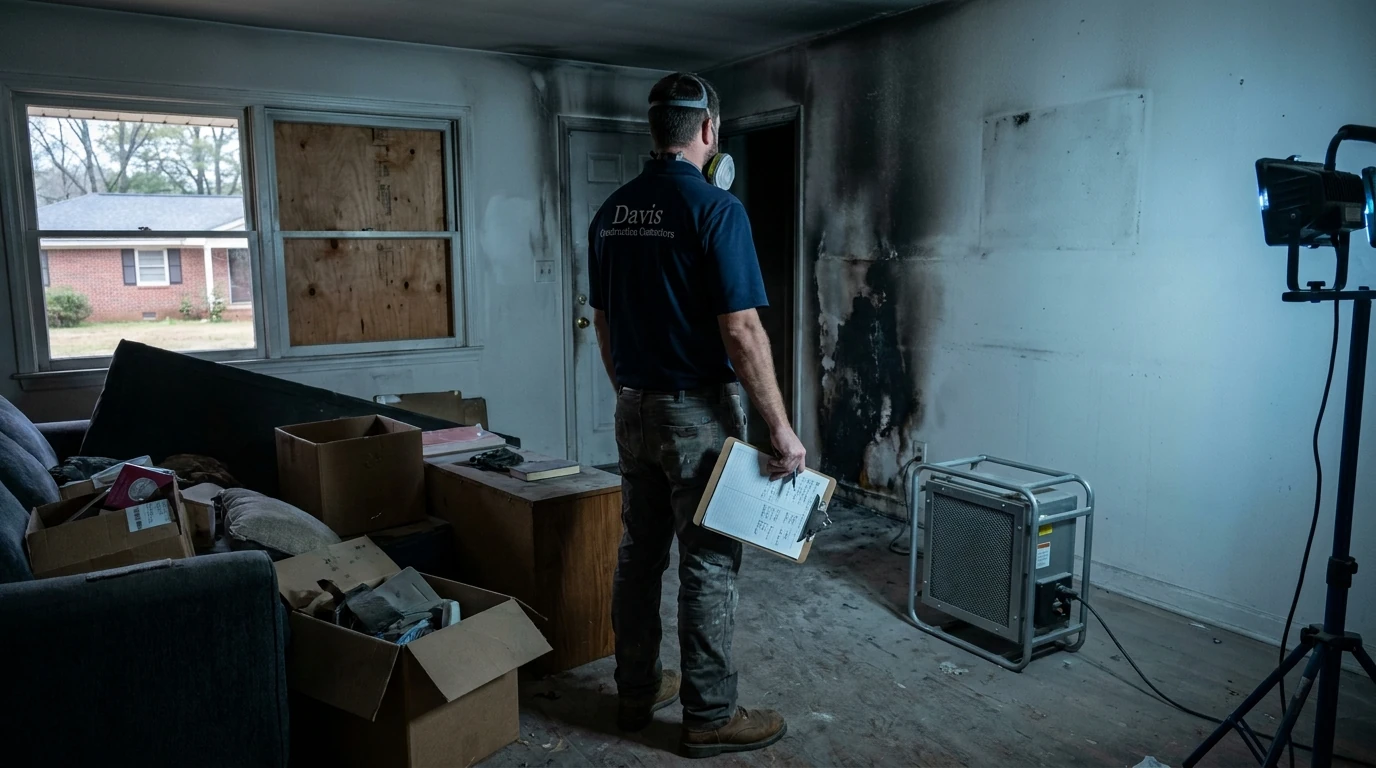
The fire is out, the trucks are gone, and you’re standing in front of your home trying to figure out what happens next. The next 24 to 48 hours will shape your insurance claim, your family’s safety, and how quickly your home gets back to livable. Here is a clear, step-by-step breakdown of what to do, in order, starting right now.
Step 1: Do Not Go Back Inside Until You Have Clearance
This is the most important rule in the first few hours. Even if the fire looked contained to one room, the structure may be compromised. Smoke and combustion byproducts settle into every surface, including ductwork, insulation, and wall cavities. Carbon monoxide can linger in enclosed spaces long after flames are extinguished.
Wait for the fire marshal or incident commander to formally release the property. They will tell you whether the home is safe to enter and whether it has been tagged with a placard indicating structural status. A yellow or red placard means do not enter without professional escort. Take that seriously.
If you have nowhere to stay, the American Red Cross provides emergency shelter assistance at no cost. Call 1-800-RED-CROSS or visit your local chapter. FEMA’s Individuals and Households Program can also provide short-term housing assistance after a declared disaster.
Step 2: Call Your Insurance Company Within the First Few Hours
Your homeowners policy almost certainly requires “prompt notification” of a loss. That language is not decorative. Delays in reporting can complicate your claim or give the insurer grounds to question coverage.
When you call, have the following ready:
- The address and date of the fire
- A brief description of what happened and which areas were affected
- Whether the fire department responded (they will have a report number)
- Your policy number if you have it
The insurer will assign a claims adjuster and typically dispatch them within 24 to 72 hours. Ask specifically about:
- Additional Living Expenses (ALE) coverage: Most standard HO-3 policies cover hotel, meals, and temporary housing while your home is uninhabitable. Get confirmation in writing.
- Contents coverage: Personal property inside the home is typically covered at actual cash value or replacement cost depending on your policy.
- Advance payment: If you have immediate needs (clothing, medication, toiletries), many insurers will issue a small advance against your contents claim.
Do not sign anything the adjuster presents at the first meeting without reading it carefully. A signed proof-of-loss form locks in your claimed amount.
Step 3: Document Everything Before Touching Anything
Before any cleanup begins, walk the perimeter (exterior only, if you do not yet have interior clearance) and photograph everything. Once you are cleared to enter, document every room, every damaged item, every affected surface.
Use your phone’s video function and do a slow, narrated walkthrough. Capture:
- Charred structural elements (framing, rafters, subfloor)
- Soot patterns on walls and ceilings
- Smoke-stained contents
- Water damage from fire suppression (hose lines leave significant water damage that is covered under your fire claim, not a separate water claim)
- Any items that are clearly total losses
Do not throw anything away before the adjuster has seen it. Even items that look unsalvageable need to be inventoried. Create a written list of every damaged or destroyed item with approximate age and replacement value. This becomes your personal property claim.
Step 4: Secure the Property
Once you have interior clearance and your documentation is complete, the property needs to be secured against weather and unauthorized entry. Most insurers require you to take “reasonable steps to protect against further damage” or they can reduce your claim payout for losses that occurred after the fire.
Practical steps:
- Board up broken windows and doors
- Tarp any roof openings where fire or firefighting activity created penetrations
- Shut off utilities if not already done (the fire department typically handles gas; confirm with the utility company)
- Do not attempt to restore power until a licensed electrician has inspected the panel and wiring
Board-up and emergency tarping are services that restoration contractors handle as part of the initial response. If you need this done quickly, a contractor experienced in storm and fire damage can typically respond within hours.
Step 5: Understand What You Can Salvage and What You Cannot
This is where a lot of homeowners make costly mistakes. The instinct is to save everything. The reality is that some categories of items cannot be safely cleaned or decontaminated after a fire and should be discarded.
Discard immediately (do not attempt to clean or eat):
- All open food, beverages, and spices
- Food in cans or jars that were exposed to heat (the seal integrity is compromised)
- Medications that were in the affected area
- Cosmetics and personal care products
- Baby formula and infant food
Items that may be salvageable with professional cleaning:
- Hard-surface furniture (wood, metal) with soot residue but no structural damage
- Clothing and soft goods, depending on smoke saturation (professional ozone treatment or dry cleaning can recover many items)
- Electronics that were not directly in the fire zone (have these inspected before powering on; soot is conductive and can cause shorts)
- Photographs and documents (freeze-dry or air-dry immediately; do not use a microwave or heat source)
Structural materials that require professional assessment:
- Drywall with soot penetration (soot contains acidic compounds that continue to etch and corrode surfaces over time)
- Insulation in attic or wall cavities
- HVAC ductwork (smoke travels through duct systems and deposits throughout the house)
Step 6: Do Not DIY the Soot Cleanup
Soot is not dirt. It is a complex mixture of carbon particles, acids, aldehydes, and other combustion byproducts. Wiping soot with a wet cloth or household cleaner typically smears it deeper into porous surfaces and can permanently stain drywall, grout, and wood grain.
Professional fire restoration technicians use dry chemical sponges for initial soot removal, followed by appropriate cleaning agents matched to the surface type. HEPA air scrubbers run continuously to capture airborne particulate. Thermal foggers or hydroxyl generators are used for odor neutralization in the structure and contents.
The odor component is particularly important. Smoke odor is not a surface issue. The compounds that cause persistent smoke smell penetrate into wall cavities, subflooring, and the HVAC system. Painting over smoke-stained walls without proper odor treatment will not seal the smell and will likely violate your insurer’s scope of work requirements.
Step 7: Get a Written Scope Before Restoration Work Begins
Before any contractor starts work, get a written scope of work that itemizes every task, the materials to be used, and the cost. This document becomes part of your insurance claim file.
Your insurer’s adjuster will also produce an estimate, typically using Xactimate software. If the contractor’s scope and the adjuster’s estimate do not match, the contractor and adjuster negotiate the difference. You should not be paying out of pocket for covered work simply because the initial adjuster estimate was low.
Ask the contractor specifically:
- Are you experienced with insurance-claim restoration work?
- Will you handle direct billing to the insurer or do I need to pay and get reimbursed?
- What is the timeline from scope approval to project completion?
- How will contents be inventoried and stored during reconstruction?
What Comes After the First 48 Hours
Once the immediate steps are handled, fire restoration typically moves through three phases: stabilization and drying (water from suppression must be extracted and dried to prevent secondary mold growth within 48 to 72 hours of saturation), cleaning and deodorization, and structural reconstruction.
The reconstruction phase, which involves replacing drywall, framing, flooring, roofing, and finishes, is where a full-service general contractor becomes essential. Storm damage and fire damage often overlap in scope: a fire that compromises the roof creates immediate weather exposure, and the repair sequence matters for both the insurance claim and the structural integrity of the rebuild.
Davis Construction Contractors handles storm damage response and reconstruction work across Madison, Huntsville, and Athens. If you need an assessment of what your home needs after a fire, call (256) 771-0326 to schedule a walkthrough.
