
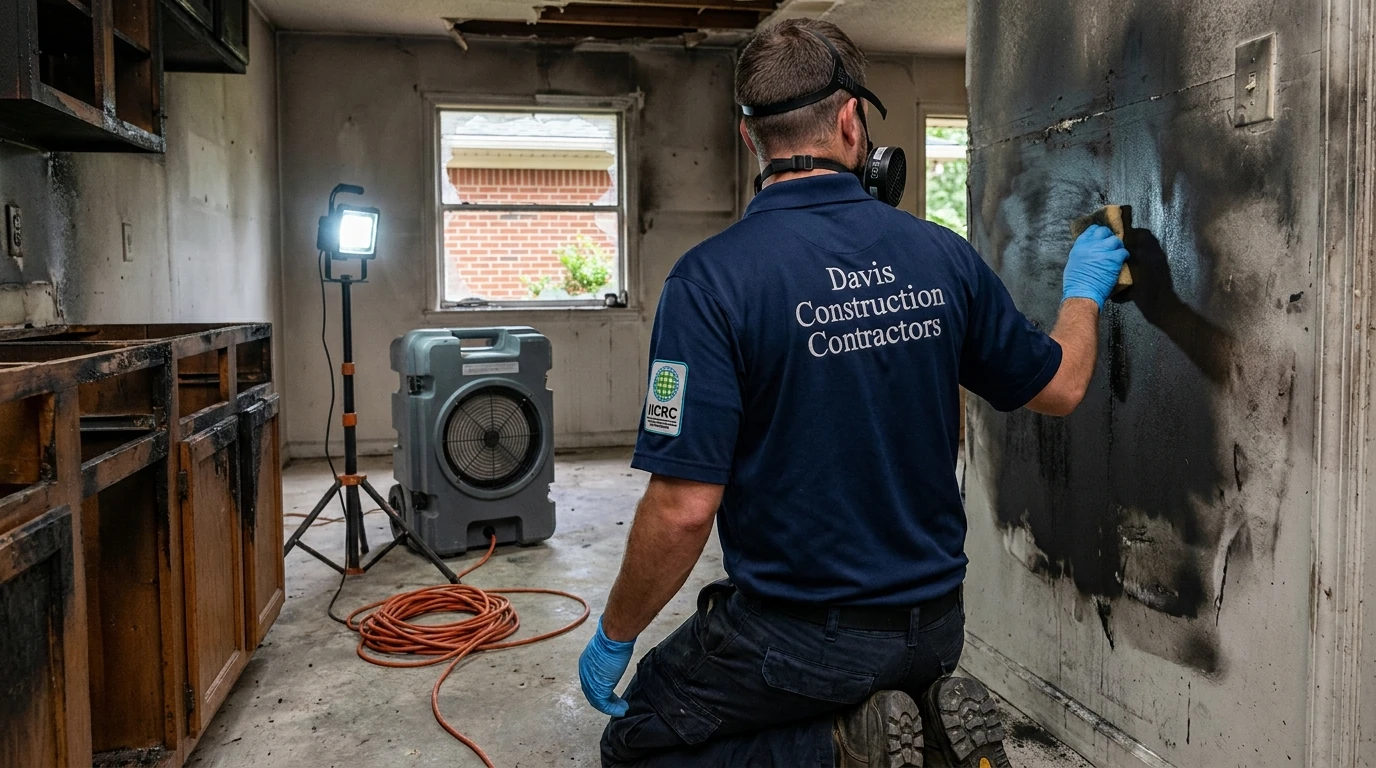
If you’re standing in a smoke-damaged home trying to figure out whether to file an insurance claim or pay out of pocket, you need real numbers — not a range so wide it’s useless. The honest answer: residential fire damage restoration in Alabama typically runs between $3,000 and $75,000, with most single-room incidents landing in the $8,000 to $25,000 range. What pushes your job toward either end of that range comes down to five specific factors, and understanding them before you talk to a contractor will help you evaluate every estimate you receive.
What Actually Drives the Cost
Fire restoration isn’t a single service — it’s a sequence of overlapping trades: emergency stabilization, water extraction (firefighting hoses deliver hundreds of gallons), structural assessment, soot and smoke remediation, odor neutralization, and reconstruction. Each phase has its own labor and materials cost, and each one depends heavily on what your home is made of and how far the damage traveled.
1. Scope of damage (square footage affected)
Contractors price fire restoration partly by affected area, but “affected” includes rooms that weren’t on fire. Smoke and soot migrate through HVAC systems, wall cavities, and door gaps within minutes of a fire starting. A kitchen fire that burns for 20 minutes can deposit measurable soot in every room of a 2,000-square-foot house. Expect to pay $4 to $12 per square foot for smoke cleaning alone on lightly affected areas, and $15 to $30 per square foot for heavily charred or structurally compromised zones.
2. Building materials
This is where Alabama’s housing stock creates real cost variation. Older homes in Huntsville’s Twickenham Historic District — many built in the 1920s through 1950s — commonly have plaster walls over wood lath. Plaster is porous and absorbs smoke compounds deeply; you can’t simply wipe it down. Restoration often requires skim-coating or full replastering, which runs $8 to $15 per square foot versus $3 to $6 per square foot for standard drywall replacement. Newer Madison subdivision homes built in the 2000s and 2010s use standard 5/8” drywall, which is cheaper to replace but also easier to cut out and reinstall cleanly.
Hardwood floors, solid wood cabinetry, brick fireplaces, and exposed timber framing all absorb smoke differently — and all require different cleaning chemistry and labor time.
3. Smoke penetration depth
This is the variable most homeowners underestimate. Smoke is not just a surface stain. Protein smoke from kitchen fires (grease, food) leaves an almost invisible film that smells intensely and requires enzymatic cleaning. Synthetic smoke from burning plastics, foam furniture, or electrical insulation contains volatile organic compounds that penetrate drywall paper and wood grain. Restoration contractors use ATP (adenosine triphosphate) testing and air quality meters to measure penetration depth — and the deeper the penetration, the more material has to come out rather than be cleaned in place.
A surface-level soot cleaning with dry chemical sponges and HEPA vacuuming might run $500 to $2,000 for a single room. If smoke has penetrated wall cavities, the same room can cost $8,000 to $15,000 once you factor in drywall removal, cavity cleaning, sealing, and reinstallation.
4. Water damage from firefighting
Every structure fire involves water — either from sprinklers or fire department hoses. A single 1.75” fire hose flowing at 150 gallons per minute can deliver 3,000 gallons in 20 minutes. That water saturates subfloors, wall cavities, and insulation, and it has to be extracted and dried before reconstruction can begin. Water extraction and structural drying typically adds $2,500 to $12,000 to a fire restoration job, depending on how much water was used and how long it sat before mitigation started. If you’re researching this alongside water damage costs, the water damage restoration cost guide covers the drying phase in more detail.
5. Odor neutralization
Smoke odor is not cosmetic — it’s a chemical contamination issue. Thermal fogging, ozone treatment, and hydroxyl generator treatment are the three primary methods. Ozone is effective but requires the structure to be unoccupied during treatment and for several hours after. Hydroxyl generators are slower but safe for occupied spaces. Thermal fogging penetrates wall cavities and HVAC ducting. Most full-house odor treatments run $500 to $3,000 depending on square footage and the number of treatment cycles required.
Room-by-Room Cost Estimates
These ranges assume moderate damage — not a total loss, but more than surface soot. They include cleaning, drywall repair or replacement, odor treatment, and repainting. They do not include structural reconstruction, which adds significantly.
| Room | Typical Restoration Cost | Notes |
|---|---|---|
| Kitchen (fire origin) | $15,000 – $40,000 | Cabinet replacement, appliance removal, subfloor, smoke penetration into adjacent walls |
| Living room | $8,000 – $20,000 | Flooring, drywall, contents, HVAC duct cleaning |
| Bedroom | $5,000 – $15,000 | Drywall, flooring, closet contents, odor treatment |
| Bathroom | $3,000 – $10,000 | Tile and grout absorb smoke; vanity and drywall often replaced |
| Attic | $4,000 – $18,000 | Insulation removal and replacement, rafter cleaning or replacement, air sealing |
| Basement | $5,000 – $20,000 | Concrete absorbs smoke; water from firefighting often pools here |
| Garage | $4,000 – $15,000 | Drywall, stored contents, possible structural damage to fire-rated wall assembly |
| Whole house (severe) | $50,000 – $125,000+ | Full structural assessment, total contents loss, reconstruction |
For context on the lower end: a grease fire contained to a kitchen range hood, caught within minutes, with no structural damage, might run $3,000 to $8,000 for cleaning, repainting, and odor treatment. For context on the upper end: a fire that burns for 30+ minutes and involves the attic or wall framing can approach or exceed the cost of rebuilding.
The Twickenham vs. Madison Subdivision Difference
If you own an older home in Huntsville’s Twickenham Historic District or Five Points neighborhood, budget 20 to 40 percent more than the table above suggests. Here’s why:
- Plaster walls: Replastering is a specialty trade. Labor runs $8 to $15 per square foot versus $3 to $5 for drywall. Matching historic plaster profiles adds more.
- Old-growth wood: Pre-1950s framing lumber is dense, resinous old-growth pine. It’s more resistant to fire than modern lumber, but it also holds smoke compounds differently and may require more aggressive chemical treatment.
- Preservation requirements: Homes in Huntsville’s historic overlay districts may require specific repair methods and materials to maintain historic designation. That limits the “just replace it” option.
- Knob-and-tube or early wiring: Older electrical systems often need full replacement after fire exposure, adding $8,000 to $20,000 for a whole-house rewire.
Newer homes in Madison subdivisions — Liberty Park, Blue Springs, Bradford Creek — have a different cost profile. Standard drywall, modern electrical, and engineered lumber make reconstruction more straightforward. The tradeoff: open-cell spray foam insulation used in some newer builds absorbs smoke and odor aggressively and often has to be completely removed.
What Insurance Typically Covers
Most standard HO-3 homeowners insurance policies cover fire damage caused by sudden, accidental events — including the water damage from firefighting efforts. What they cover specifically:
- Structural repairs and reconstruction (dwelling coverage, Coverage A)
- Personal property replacement (Coverage C, usually at actual cash value unless you have replacement cost endorsement)
- Additional living expenses while the home is uninhabitable (Coverage D)
- Smoke and soot damage to adjacent rooms, even if the fire didn’t reach them
What commonly creates disputes:
- Pre-existing electrical issues that contributed to the fire (insurers may argue negligence)
- Detached structures (covered under Coverage B, usually at 10% of dwelling coverage)
- High-value items (jewelry, art, electronics) that exceed standard sub-limits
Most fire claims involve a public adjuster or a contractor-prepared scope of work. Before accepting an adjuster’s initial estimate, get an independent written scope from a restoration contractor. The homeowners insurance fire damage coverage guide covers what to document and how to navigate the claims process.
How to Get an Accurate Estimate
Fire damage estimates vary widely because the scope isn’t fully visible until demolition begins. A reputable contractor will:
- Conduct a full walkthrough with a moisture meter and air quality monitor before quoting
- Provide a line-item written scope (not a lump-sum number) that separates mitigation from reconstruction
- Identify what can be cleaned versus what must be replaced — this is where estimates diverge most
- Coordinate with your insurance adjuster directly if you’re filing a claim
Be cautious of any estimate that doesn’t include a demolition and assessment phase. Until damaged drywall is opened and wall cavities are inspected, no one can give you a reliable final number.
If you’ve had a fire in your home and need a written scope for an insurance claim or your own planning, Davis Construction Contractors serves Madison, Huntsville, Athens, and surrounding areas. Request a fire damage assessment at (256) 771-0326.