If your house caught fire last night and you’re sitting in a hotel room trying to figure out whether your insurance will actually pay for this, the short answer is: yes, for most homeowners with a standard HO-3 policy, accidental fire damage is covered. But the details matter more than the headline, and the next 48 to 72 hours are the most important window for protecting your claim.
What a Standard HO-3 Policy Actually Covers After a Fire
Most homeowners insurance policies written in Alabama are HO-3 open-peril policies, which means your dwelling is covered against all causes of loss except those specifically excluded. Accidental fire is not excluded. It’s one of the most clearly covered perils in the policy, and it triggers several coverage buckets at once.
Dwelling coverage (Coverage A) pays to repair or rebuild the physical structure of your home, including attached garages and built-in appliances. This is the largest bucket. If your policy has a $300,000 dwelling limit and the fire caused $180,000 in structural damage, Coverage A handles that repair cost up to the limit, minus your deductible.
Other structures (Coverage B) covers detached garages, fences, sheds, and pergolas at roughly 10% of your dwelling limit by default. If you have a detached workshop or a fence line that caught embers, this is where that claim lands.
Personal property (Coverage C) covers your furniture, clothing, electronics, and household contents. The default is typically 50-70% of your dwelling limit, but there are sub-limits for specific categories. Jewelry, firearms, fine art, and collectibles are commonly capped at $1,500 to $2,500 per category unless you’ve added a scheduled personal property endorsement. If you lost a gun collection or a set of antique watches in the fire, those sub-limits will matter.
Loss of use (Coverage D) pays your additional living expenses while your home is being repaired. Hotel bills, restaurant meals above your normal food budget, laundry costs, and temporary rental housing all qualify. Most policies cap this at 20-30% of your dwelling limit and run it for a defined period, often 12 to 24 months.
Smoke Damage: Covered, But Read the Fine Print
Smoke damage is covered under the same HO-3 framework as fire damage, but it creates its own complications during the claims process. Smoke travels through HVAC systems, penetrates wall cavities, and settles into porous materials like drywall, insulation, and wood framing in rooms that never saw flames. Adjusters sometimes scope smoke damage conservatively on the initial estimate.
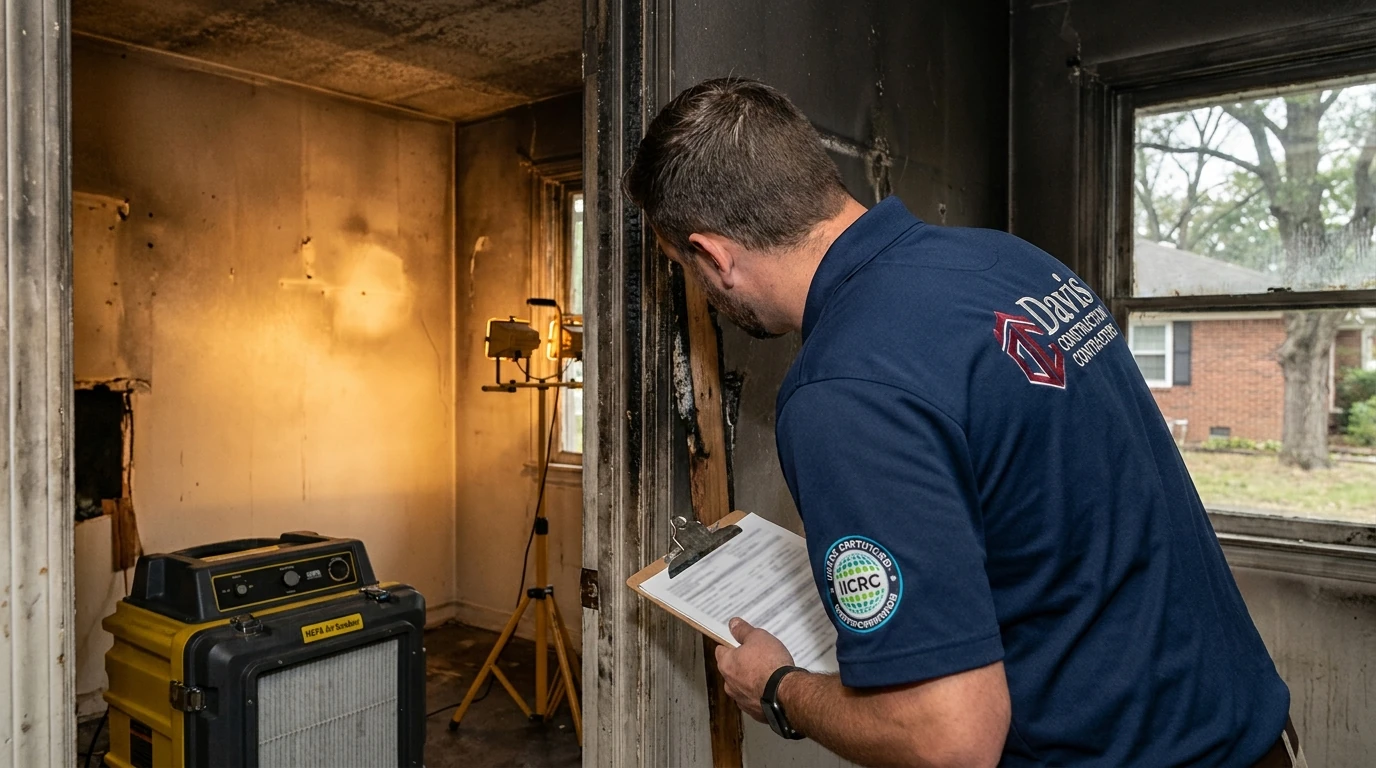
If your kitchen caught fire but the HVAC distributed smoke odor throughout the house, the full scope of smoke remediation belongs in your claim. This includes HEPA air scrubbing, ozone or hydroxyl treatment, duct cleaning, and in some cases, full content pack-out and cleaning. A restoration contractor who documents the spread of smoke damage with air quality readings and surface sampling gives you a much stronger position with the adjuster than a verbal description of “it smells bad.”
Soot residue on walls and ceilings is not cosmetic. It’s acidic and continues to corrode surfaces and electronics if left untreated. The longer it sits, the more secondary damage accumulates. Most policies cover that secondary damage if it’s documented as resulting from the original fire event, but the documentation window closes fast.
What Homeowners Insurance Does NOT Cover After a Fire
Several exclusions apply specifically to fire claims, and they catch people off guard.
Arson by the policyholder is excluded under every standard policy. If investigators determine the fire was intentionally set by the insured or someone acting on their behalf, the claim will be denied and the matter referred to the insurer’s special investigations unit. In Alabama, this is a criminal matter as well as a civil one. Most standard HO-3 policies in Madison and Huntsville cover accidental fire, including fires caused by negligence, but the arson exclusion is absolute.
Vacant property is a common trap. Most policies define a home as “vacant” after 30 to 60 consecutive days without a resident. If you were in the process of selling a home or had recently moved out and a fire occurred, your insurer may invoke a vacancy exclusion or reduce the payout significantly. Check your policy’s vacancy clause if this applies to your situation.
Gradual deterioration and deferred maintenance can create coverage disputes on fire claims. If an electrical fire started in a panel that building inspectors or prior reports had flagged as hazardous and you hadn’t addressed it, the insurer may argue that the loss was foreseeable and partially attributable to neglect. This doesn’t automatically void the claim, but it can complicate it.
Flood-driven fires (for example, a transformer fire caused by flooding) may fall into a gray zone depending on how the policy defines concurrent causation. If a storm event contributed to the fire, your adjuster may route part of the claim to a separate flood or storm policy. If you have storm damage alongside fire damage, those claims sometimes need to be handled in coordination.
Total Loss Provisions: When the House Can’t Be Saved
If the fire damage is severe enough that the cost to repair exceeds a defined threshold, typically 50-75% of the insured value depending on the insurer and state, the property may be declared a total loss. Alabama follows an “economic total loss” standard in most cases, meaning the insurer compares repair cost to the property’s pre-loss value.
A total loss declaration changes the claim significantly. Instead of a repair scope, you’re negotiating a settlement based on your Coverage A limit and the policy’s replacement cost versus actual cash value provisions. Replacement cost value (RCV) policies pay what it costs to rebuild at today’s prices. Actual cash value (ACV) policies depreciate the payout based on the age and condition of the structure. The difference on a 20-year-old home can be substantial.
If your policy has a guaranteed replacement cost endorsement, the insurer is obligated to pay the full rebuild cost even if it exceeds your Coverage A limit. Not all policies include this. Check your declarations page.
How to Protect Your Claim in the First 48 Hours
The decisions you make in the first two days after a fire have a direct impact on your claim outcome.
- Call your insurer and open the claim immediately. Most policies require prompt notice. Waiting 72 hours is usually fine; waiting two weeks is not.
- Document everything before any cleanup. Photograph every room, every damaged item, every surface. Video walkthroughs are better than photos alone. If fire investigators or the fire marshal are still on scene, ask them for their incident report number.
- Do not discard damaged contents. Your insurer’s adjuster needs to see the damage to scope it accurately. Throwing out a charred couch before the adjuster visits can reduce your personal property payout.
- Request a written scope from the restoration contractor before work begins. A detailed line-item scope, not a verbal estimate, gives you and your adjuster a shared reference point. It also protects you if the insurer tries to reduce the scope mid-project.
- Track every additional living expense. Save hotel receipts, restaurant receipts, and any other costs you’re incurring because you can’t live in your home. These are reimbursable under Coverage D.
For a more detailed walkthrough of the immediate post-fire steps, see our guide on what to do after a house fire.
Working with an Adjuster vs. a Public Adjuster
Your insurer will assign a staff adjuster or an independent adjuster to your claim. That adjuster works for the insurance company. They’re not adversarial, but their job is to scope the loss accurately from the insurer’s perspective, which sometimes means a more conservative initial estimate than what full remediation actually requires.
A public adjuster works for you and takes a percentage of the final settlement, typically 10-15%. On large or complex claims, particularly total losses or claims with significant smoke and contents damage, a public adjuster can increase the settlement enough to more than cover their fee. On smaller, straightforward claims, they may not add enough value to justify the cost. It’s worth a consultation before deciding.
A licensed restoration contractor who works directly with insurance companies and provides detailed, line-item scopes is a middle path that many homeowners find effective. The contractor advocates for a complete scope without the public adjuster’s fee structure.
Davis Construction Contractors handles fire and smoke damage restoration in Madison, Huntsville, and Athens, and works directly with insurance carriers to document and scope fire losses accurately. If you’re in the early stages of a fire damage claim and want a professional assessment before the adjuster’s first visit, request a fire damage assessment at (256) 771-0326.
