Fire and Smoke Damage Rebuilding in Madison
Trusted fire and smoke damage rebuilding in Madison and surrounding areas. Licensed general contractor, free estimates, on-time and on-budget. Call (256) 771-0326.
Smoke moves faster than fire. By the time flames are out, soot has already traveled through HVAC ducts, settled into wall cavities, and bonded to cool surfaces in rooms that never burned. The smell that hits you three days later, the oily film on kitchen cabinets two hallways from the origin point, the drywall that looks intact but smells like a campfire inside the wall: these are the problems that a paint-and-patch approach will not solve. Fire and smoke damage rebuilding is a different discipline than general contracting, and the gap between doing it right and doing it fast shows up months later.
What Fire and Smoke Damage Rebuilding actually involves
Fire losses have two distinct damage categories that require separate scopes of work: structural damage from heat and flame, and residue damage from smoke, soot, and off-gassing. Both have to be addressed before any rebuilding begins, or the new materials absorb the contamination from the old ones.
Soot is not uniform. Protein soot from kitchen fires is nearly invisible but extraordinarily pungent and bonds tightly to painted surfaces. Synthetic soot from burning plastics, insulation, or modern furnishings is oily, dark, and acidic, and it continues to etch metal and glass for days after the fire is out. Wood soot falls somewhere between the two. Each type responds to different cleaning chemistry, and misidentifying the soot type is one of the most common reasons a rebuilt room still smells like fire six months later.
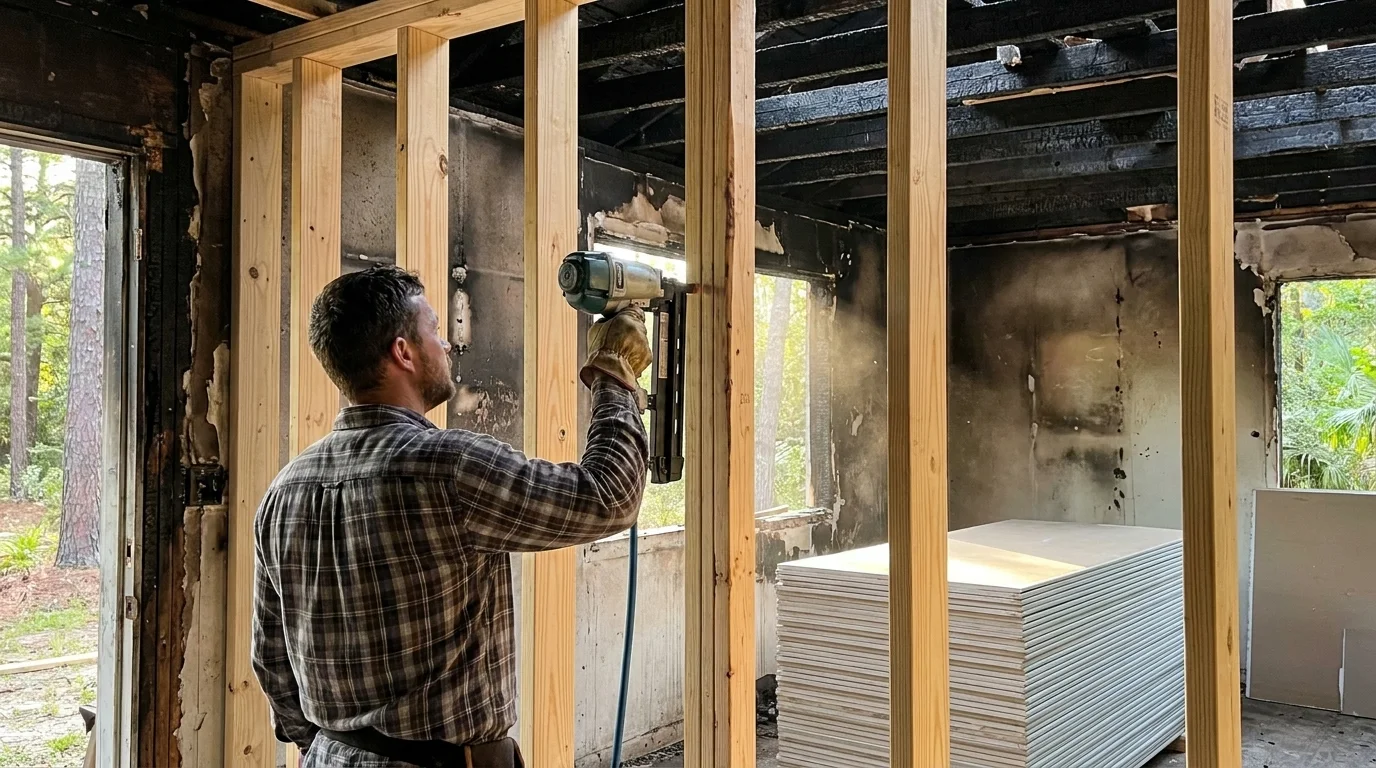
Beyond soot, structural rebuilding after a fire typically involves removing and replacing charred framing members, inspecting subfloor and roof sheathing for heat delamination, replacing insulation that has absorbed smoke, and coordinating electrical and HVAC inspections before walls close. In Madison and the surrounding area, permits are required for structural repairs, and the work must pass inspection before finish materials go in.
Our process
-
Damage assessment and soot characterization. Before any cleaning or demolition begins, the affected areas are mapped and the soot types are identified. This determines which cleaning agents, application methods, and containment measures are appropriate. Structural members are probed and photographed to document the scope for both the rebuild plan and the insurance carrier.
-
Controlled demolition and debris removal. Charred framing, smoke-saturated insulation, and unsalvageable drywall are removed under containment to prevent cross-contamination to unaffected areas. HVAC registers are sealed during this phase so demolition dust and residual soot do not recirculate through the duct system.
-
Odor neutralization before rebuild. This step is skipped more often than it should be. Thermal fogging or hydroxyl treatment penetrates porous surfaces, subfloor gaps, and wall cavities to break down odor-causing compounds at the molecular level. Sealing over untreated surfaces with primer traps the odor temporarily but does not eliminate it. Rebuilt rooms that still smell like smoke almost always skipped this step.
-
Structural rebuilding and systems coordination. Framing, sheathing, and subfloor repairs are completed to code. Electrical, plumbing, and HVAC contractors are coordinated at the right sequence so inspections can proceed without delays. In Madison, building permits for structural fire repairs are pulled before framing work begins.
-
Finish work and final inspection. Insulation, drywall, paint, trim, flooring, and fixture reinstallation follow the permitted rebuild scope. A final walkthrough confirms that odor, structural integrity, and finish quality all meet the documented scope before the project is closed out.
What separates a good fire damage response from a bad one
The most common mistake in fire damage rebuilding is treating it as a cosmetic job. New drywall over smoke-saturated framing, fresh paint over unprimed soot residue, and flooring installed before odor treatment is complete: these shortcuts produce callbacks, failed inspections, and persistent odor complaints.
Insurance adjusters look for documentation at every phase. Photographs of soot type and distribution, moisture readings in structural members (fire suppression water creates secondary damage), and a written scope tied to line-item quantities are what move a claim forward. Vague invoices and undocumented demolition slow approvals and create disputes over what was actually damaged.
A detail that gets missed on partial-loss fires: smoke migrates to the coldest surfaces in a structure. Exterior walls, attic spaces, and crawlspaces in rooms far from the fire origin often carry significant residue that a room-by-room visual inspection will not catch. Skipping those areas and rebuilding only the obviously damaged rooms is a reliable way to end up with a house that still smells like fire.
What does Fire and Smoke Damage Rebuilding cost?
Typical costs for fire and smoke damage rebuilding vary widely based on the size of the affected area, the soot type, the extent of structural damage, and whether systems (electrical, HVAC, plumbing) require inspection or replacement. Most homeowners pay somewhere in the ranges below for common loss scenarios, though every fire loss is different and Davis Construction Contractors provides a written scope of work before any work begins.
| Scenario | Typical industry range |
|---|---|
| Single-room smoke damage, no structural loss | $3,500 - $8,000 |
| Kitchen fire with moderate structural damage | $15,000 - $40,000 |
| Partial loss (one floor or wing of home) | $40,000 - $90,000 |
| Whole-home smoke saturation, structure intact | $25,000 - $60,000 |
| Significant structural loss requiring full rebuild | $90,000 - $250,000+ |
Homeowners insurance typically covers fire and smoke damage rebuilding, including structural repairs, odor remediation, and contents pack-out, subject to your policy’s deductible and coverage limits. Documenting the full scope before work begins is the single most important factor in a smooth claim.
Seasonal and regional considerations
North Alabama’s climate adds a layer of complexity to fire losses that occurs less often in drier regions. High humidity, particularly from late spring through early fall, accelerates mold growth in structural cavities that were wetted by fire suppression. A fire loss in July in Madison can develop secondary mold contamination within days if wet framing is enclosed without adequate drying. Coordinating moisture readings alongside the fire damage scope is standard practice here, not an upsell.
Winter losses in the area carry a different risk: heating system fires, chimney fires, and space heater ignitions are more common from November through February, and the same cold surfaces that attract soot residue also slow the evaporation of suppression water. Both seasonal patterns affect the timeline and scope of a proper rebuild.
Service area
Davis Construction Contractors is based in Madison, AL and serves fire damage rebuild projects throughout Madison County and the surrounding communities, including Huntsville, Decatur, Athens, and Hartselle. City-specific pages cover local permitting contacts and regional considerations for each area.
If your home or property has been through a fire, the clock on secondary damage starts the moment suppression ends. Call Davis Construction Contractors at (256) 771-0326 to begin smoke and soot removal and get a written rebuild scope in hand.
Frequently Asked Questions
Does homeowners insurance cover fire and smoke damage rebuilding?
What is the difference between protein soot and synthetic soot, and why does it matter for cleanup?
Why does my house still smell like smoke even after the damaged rooms were repainted?
Do I need a permit to rebuild after a house fire in Madison, AL?
How do I know if fire suppression water has caused mold growth inside my walls?
Looking for the best fire and smoke damage rebuilding company in Madison?
Davis Construction Contractors provides fire and smoke damage rebuilding in Madison, AL and the surrounding area, and has served local property owners since 2008. Customers rate us 4.1 out of 5 stars across 55 Google reviews. Call (256) 771-0326 during business hours (Monday–Friday, 8:00 AM – 5:00 PM) for a free estimate.
Need Fire and Smoke Damage Rebuilding now?
We serve Madison and surrounding AL cities. Family-owned, licensed & insured.
Related Coverage
- Our Restoration Services
- Contact Davis Construction Contractors
- Construction Services in Arab
- Construction Services in Ardmore
- Restoration Services in Athens
- Construction Services in Decatur
- Construction Services in Elkmont
- Construction Services in Gurley
- Construction Services in Hartselle
- Construction Services in Harvest
- Construction Services in Hazel Green
- Restoration Services in Huntsville
- Construction Services in Meridianville
- Construction Services in Moores Mill